
2025 Student Scholars
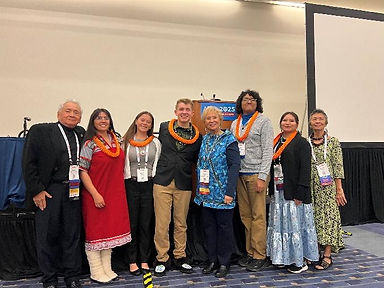
2025 Student Scholars
The American Indian, Alaska Native, Native Hawaiian (AIANNH) Caucus of the American Public Health Association (APHA) encourages Indigenous students from across the country to apply for the Margo D. Kerrigan Travel Scholarship, an award named after the AIANNH Caucus founder who was the first American Indian professional to serve on the APHA Executive Board. In Margo’s honor, the award provides scholars the opportunity to fully participate in the APHA Annual Meeting & Exposition each year, promoting achievement and promise in growing Indigenous public health professionals.
Michael Bird, Jennie Holmes, Lei’ohu Turley, Luke Layman, Patricia Cochran, Macaiah Shendo, Jessica Denetdeal, Babette Galang
This year, 5 students were selected to receive the 2025 Margo Kerrigan Scholarship: Jennie Holmes (American Indian), Macaiah Shendo (American Indian), Luke Layman (Alaska Native), Jessica Denetdeal (American Indian), and Lei’ohu Turley (Native Hawaiian). Students represented Dartmouth College, University of New Mexico, University of Colorado, Dine College, and University of North Dakota. We had 2 undergraduate students, 2 Master’s students, and one PhD student. The students came from various tribal backgrounds including Native Hawaiian, Navajo, Orutsararmuit Traditional Native Council, and the Pueblos of Jemez, Sandia, and Isleta.

The Margo Kerrigan scholarship provides students roundtrip airfare, lodging, APHA
registration and membership, AIANNH Caucus membership, and a stipend for baggage, meals, and ground transportation – representing a cost of approximately $2000 per student. As part of their scholarship agreement, students are required to participate in the AIANNH Caucus Executive Board Meeting, the General Caucus Membership Meeting, the Caucus Social, and the Wisdom of the Elders session. They are also afforded the opportunity to attend other APHA events and sessions that pique their interest, browse and network at the Expo, and meet with other Public Health professionals throughout the meeting. The Margo Kerrigan scholarship provides an enriching and powerful opportunity for aspiring Indigenous Public Health Professionals to seek new opportunities and build a foundation for their education and career.
The following are reflections shared by the 2025 Margo Kerrigan Scholars.

Lei’ohu Turley
Dartmouth College, Undergraduate Student
First off, I want to thank the Caucus for allowing me the opportunity to attend the APHA conference. It is an understatement to say that I learned so much. I grew up very passionate about food systems and food sovereignty coming from an island, and only until this conference did I realize the full extent of food on public health. One of the first sessions I went to independently was a presentation on the correlation of food insecurity and climate change vulnerability. The research found that the communities experiencing the harshest climate change effects are also those experiencing the most food insecurity. It made me think of my home and how our entire island chains are food insecure due to our dependency on shipments from around the world. In addition to this insecurity, our islands are also experiencing the earliest effects of climate change, such as biodiversity loss, erosion, and unprecedented climate events. A lot of my interests within environmental studies relate to the intersection of water accessibility and food access. In many Indigenous communities, our traditional food systems are pillars in our communities health. And when Indigenous peoples are denied our right to develop our food systems through a lack of water, our populations suffer. This was the perspective I brought to the conference and I am so glad to have learned so much from conversations that relate outside of Hawai’i.
I also had time to go to sessions that I had little knowledge in. For example, I went to a session on the new form Christianity and its effects on public health. The panelists argued that the far right form of Christian nationalism is detrimentally fueling distrust within public health and is leading to the delegitimization of decades of scientific research. A point that remains with me is the comparison between African American distrust of health systems and the current white mistrust of health systems. What was brought up was that African Americans have historical precedent to fear the health care field due to generations of systemic racism and ignorant providers. However, the panelist questioned what has led to this white mistrust when there is no historical precedent for it. And a peer panelist brought up how the pandemic led to mistrust due to the shutting down of churches as non essential spaces.
Lastly, I wanted to reflect on the Wisdom of the Elders session and how it was a deeply grounding experience for me. I have been away at school for three months now and have been challenged by the lack of elders surrounding me. This experience brought me back to the ground and out of my studies. Aunty Patricia told us to never forget who we are in the midst of a western education, and I took that to heart. It is easy being across the country to get wrapped up in the fast-paced culture. However, the elders reminded me that taking care of what brought us to these institutions is far more important. I hope to take back all of this wisdom and guidance I’ve gained through this experience to finish the first half of my sophomore year of college. I am incredibly grateful for this opportunity and look forward to giving back to both the caucus and my community as a way to reciprocate these gifts. I’ve realized just how far public health reaches and just how far our communities must go to serve our peoples, and I am excited to have met so many within the effort.

Macaiah Shendo
University of New Mexico, Master of Public Health
The American Public Health Association was the best conference I have ever attended. Initially the number of people in attendance was quite overwhelming, but with help from members of the American Indian, Alaska Native, and Native Hawaiian Caucus (AIANNH Caucus) it was far more manageable. Being awarded the Margo D. Kerrigan Travel Scholarship was a very high honor and it allowed me to travel to a remarkable conference where I met some of the most talented Indigenous public health practitioners in the world. I was also able to connect with my former internship director and junior alumni from the internship that recognized me and wanted to connect. Having the ability to attend the large number of sessions was also incredibly special as there were sessions on brain health which is my passion area. Aunty Patricia, Aunty Babette, and Uncle Michael were all so incredibly welcoming and it was such an blessing to receive their wisdom. I had the honor of being the 2025 recipient of the Eric D. Bothwell Student Award in American Indian/Alaska Native Men’s Health and I would not have been able to present my oral presentation titled “Improving American Indian/Alaska Native Men’s Mental Health Through Neuropsychology, Public Health, and Storytelling” were it not for this scholarship.
This travel scholarship has helped my future career development and goals of becoming an Indigenous Neuropsychological Epidemiologist, potentially the very first one in the United States and much of the world. The incredible individuals I have had the opportunity to meet and build connections with will only push me to further pursue my goal of helping all native people achieve good brain health. I truly believe in the strength of our people and will work to ensure that our cultural ways live on. It was truly an honor to attend this conference, and it really has changed my life. Thank you to all of the people who made this possible from the bottom of my heart.

Jessica Denetdeal
Dine College, Undergraduate Student
This summer of 2025, I attended a two week away program in North Dakota through AIHEC. It was informational and through that program, I met an individual named “Rose.” Because of Rose, I was able to learn about this scholarship. I read through it and applied. There was a feeling of doubt because I knew that there would be so many students applying for this wonderful scholarship. This scholarship was called the Margo D. Kerrigan travel scholarship. A couple of weeks later, I saw the amil that I was selected, along with four other scholars.
In the weeks leading to the conference, we were given information about our flights and hotel stay. This scholarship was able to pay for my roundtrip airfare from Albuquerque, New Mexico to Washington D.C. Our hotel was right next to the conference, which was convenient and it was called the Westing Downtown D.C. I am glad that our hotel was a 3-minute walk so we didn’t have to spend extra money on Ubers or the metro. Each of us had a roommate in our hotel who was another scholar. Without this scholarship, I would not have been able to financially recover or be able to purchase everything from the flights to the hotel and meals. Another thing that was paid for by this scholarship was the conference membership!
This scholarship, other than helping me financially, helped me gain more knowledge about American Indian health, disparities, mental health, and much more. One session from the conference that stood out to me was the “Wisdom of the Elders.” This session captivated me
because us scholars, were able to ask questions that were related to public health and Native Americans/Alaska Natives/Native Hawaiians. I was grateful for this because in my personal life, I don’t have any elders around me who are willing to share their knowledge and wisdom.
Another thing is that my elders don’t speak English which is also a reflection on me and how I can do better by learning it. I learned during this session also how the Native Alaskans have homes that are flooding due to climate change. All in all, this session was beautiful and
Informative.
On the last day of the conference, I knew this whole experience persuaded me to go into public health. Currently, I am a biology major who potentially wants to do nursing or go into a physician assistant program. I met a lot of public health professionals at the AIANNH Caucus
social hour and one individual let me know about public health nursing. I never knew that there was a thing called public health nursing and now this is something I am looking into, and this conference has influenced me to do so. If I ever become wealthy and can donate thousands, I will be donating to this organization because of the wonderful opportunities that it granted to us and other scholars in this cohort and the past. This scholarship will influence students and teach them in many ways. Thank you for reading and I hope to attend the APHA conference next year and present.

Luke Layman
University of Colorado, Master of Public Health
This reflection will begin with thanks to the executive committee and Elders who were able to host and facilitate the presence of the caucus at the 2025 American Public Health Association Conference. I want to share about the people that I have gotten to know and understand in our time learning and serving our communities through public health. Sarah, Lei’ohu, Macaiah, Chez, Jessica, and Jennie- we all have unique perspectives and we are not siloed on one idea or one vision. I believe that we all have a unique purpose in our experience serving our Native communities. Our visions of the future all impact different social determinants of health- we all can narrow our stories into work with meaningful cause.
I had also met other men with the same vision for pursuing a master of public health. This was important as I had struggled to find people with similar ways of thinking and others have successfully found spaces where we use data, epidemiology, models, and methods to support capacity building with others. Each student and practitioner has been insightful to get to know and talk with. I have also attended different lectures on Asian and Pacific Islander caregiver’s health, North Carolina environmental injustice, and chemical contamination in Michigan. During one of the keynote speaking sessions, I questioned how our health systems are able to impact Alaska native people with the context I have learned throughout the beginning of studying for my master of public health.
One thought I have taken away from Wisdom of the Elders is “to be ready.”,”be kind.” and “use resources efficiently.” It has taken time for me to reflect on some of the words that were spoken that day. I also heard how we were spoken to, the words were gentle, genuine, and authentic. I heard these thoughts right there with them. These thoughts reaffirm that a positive way to achieve success in public health spaces is to share our teachings and stories with the principles and values we all have used to grow to be strong people.

Jennie N. Holmes
University of North Dakota, PhD Student
Receiving the Margo D. Kerrigan scholarship to attend APHA and join the AIANNH Caucus has been such an honor and a deeply meaningful experience. I am truly grateful for the opportunity. Being in spaces created for Indigenous people and by Indigenous people is powerful, especially in a field where our voices, knowledge systems, and community-led approaches are often underrepresented.
Throughout the conference, I felt surrounded by relatives including fellow Indigenous scholars, students, and professionals who share a commitment to the health and wellbeing of our Nations. Meeting others on similar academic and career journeys reminded me that we’re not walking this path alone. Every conversation, introduction, and shared story filled me with gratitude and renewed motivation. The sense of community within the AIANNH Caucus was uplifting, grounding, and inspiring. I look forward to staying connected with the Caucus.
The sessions and presentations gave me new tools, ideas, and approaches that I can bring back to both my academic work and my role in community programming. I left each day feeling encouraged, challenged, and excited to apply what I learned. This conference helped strengthen my approaches to Indigenous evaluation frameworks, advance culturally grounded health initiatives, and build healing-centered youth programs.
This experience reaffirmed why I am doing this work. The scholarship didn’t just support my attendance at APHA; it supported my growth, my voice, and my ability to bring knowledge home to my community. I carry deep appreciation for the Margo D. Kerrigan family, the AIANNH Caucus, and everyone who helped uphold this opportunity.
I return home inspired, connected, and committed to continuing this work with love, humility, and purpose.